

ARM’s strategic priorities to operate safely, responsibly and efficiently, and to partner with communities and other stakeholders, are founded on responsible environmental, social and governance (ESG) practices and our commitment, as ICMM members, to mining with principles.
Ultimate responsibility for monitoring the effective management of sustainable development lies with the ARM board. The board delegates this responsibility to the social and ethics committee.
The committee is constituted under regulation 43(5)(c) of the Companies Regulations promulgated under the Companies Act. Its purpose is to monitor and report on the manner and extent to which ARM protects, enhances and invests in the economy, society and natural environment in which it operates to ensure its business practices are sustainable.
The committee is responsible for monitoring specific activities under relevant legislation, other legal requirements and codes of best practice including:
The committee operates according to its terms of reference, which are regularly updated, and assumes responsibility for matters assigned by the board. It draws relevant matters to the attention of the board and reports to shareholders at annual general meetings.
The committee is supported by executive management and relevant executive committees and governance structures, including the employment equity and skills development committee. It oversees the management of ESG risks identified by the enterprise risk management (ERM) process. This in turn considers internal and external stakeholders as well as governance processes.
The committee’s terms of reference provide for a minimum of three members, with a majority of independent non-executive directors. Currently, the committee has five non-executive directors, all independent. Members have extensive experience in mining operations, human resources, sustainable development and stakeholder engagement. Invitees to meetings include the chief executive officer, executive director: investor relations and new business development, divisional chief executives, executive: risk and sustainability, group executive: human resources, group executive: legal and group executive: compliance and stakeholder relations.
| Member | Appointed |
| Dr RV Simelane (chairman) | February 2007 |
| JA Chissano | August 2019 |
| AK Maditsi | June 2012 |
| DC Noko | August 2019 |
| JC Steenkamp | April 2018 |
The committee had four scheduled meetings in F2022. Attendance is shown on page 129 of the full 2022 ESG report.
Mining and processing unlock the value in mineral reserves, catalysing growth and development. As we conduct our activities, we never lose sight of our responsibility to manage and mitigate any potential negative impacts. We recognise that we operate in a broader context and endeavour to build on our good relationships with stakeholders and engage them in open dialogue.
We share learnings and implement industry good practice across operations and with our peers in industry associations. ARM is a member of the ICMM, shares its commitment to mining with principles and has implemented its sustainable development framework. Since 2019, ARM operations and the corporate office have completed self-assessments against the ICMM’s 38 performance expectations. For the past two years, these self-assessments were validated as part of the external assurance over ESG data performed by IBIS ESG Consulting Africa Pty Ltd.
F2022 focus
In the review period, the committee:
ARM is committed to zero harm and we prioritise the safety, health and wellbeing of our employees and contractors in striving for this goal. Regrettably, two colleagues were fatally injured in separate accidents at Modikwa and Two Rivers mines in F2022. We extend our heartfelt condolences to the families of Mr Jacob Puleng Leshaba and Ms Phasoana Rheina Malatji, their friends and colleagues.
Both accidents were thoroughly investigated and the learnings and opportunities for improvement were presented to the committee. The operations implemented the remedial actions agreed with the Department of Mineral Resources and Energy (DMRE) following these incidents and initiatives are ongoing at all operations to ensure that safety training continues and safety standards are strictly upheld. These include implementing the CCM process, which is complete at Beeshoek and Black Rock mines, and at an advanced stage at the other mines. Both mines passed significant safety milestones during the year, with Black Rock Mine achieving 10 million fatality-free and Beeshoek Mine achieving 5 million fatality-free shifts, which took 13 and 18 years respectively to achieve.
The group’s integrated wellness management programme focuses on preventing occupational health hazards from affecting the health of employees and contractors, and actively identifying and managing health risks and chronic conditions that could affect their wellness and quality of life. These programmes prioritise effective management of hearing conservation, tuberculosis (TB), HIV and Aids, occupational lung diseases and chronic conditions.
Our programmes support the national agenda to address TB and HIV and Aids. Khumani, Black Rock, Beeshoek, Modikwa and Two Rivers mines have memorandums of understanding (MoUs) with the regional Departments of Health (DoH) to strengthen the implementation of provincial strategies related to TB, HIV and Aids, sexually transmitted infections and chronic disease management. The MoUs also extend primary healthcare services to contractors and communities. The clinics continue to engage other stakeholders such as the DoH and community NGOs in conducting wellness campaigns in the workplace and the community, which include TB and HIV and Aids awareness and outreach.
We continued to proactively prevent the spread of Covid-19 through strict health and safety measures at all operations and ARM corporate office. A total of 7 716 employees were tested in F2022, with 1 891 positive tests. 99% of positive cases recovered compared to the national rate of 96.3%. Sadly, we lost 12 of our colleagues during the year, bringing to 46 the number of colleagues we have lost to Covid-19 since the onset of the pandemic. We extend our condolences to their families, friends and colleagues.
Initiatives to promote vaccination continue and at year end 14 939 employees were fully vaccinated, representing 73% of the workforce, compared to the mining industry figure of 75% and national rate of 51%. 2 683 community members were vaccinated at ARM-managed sites during the year.
Implementation of the group diversity management policy is overseen by the employment equity and skills development committee. Transformation is embedded in succession planning, management recruitment, selection and promotion to improve representation of historically disadvantaged persons (HDPs) and women, which continues to increase at all management levels. Skills development is critical for developing internal talent and, in F2022, ARM invested R198 million in these programmes. The majority of candidates on our leadership development programmes are HDPs and a high proportion are women.
Gender mainstreaming continues across the group, with the gender mainstreaming and development framework integrating a gender perspective into all phases of planning cycles, policies, programmes and projects. We have engaged a labour law specialist to conduct a high-level evaluation of group policies for gender sensitivity that will be rolled out to the operations.
These initiatives form part of ARM’s broader focus on transformation, which includes HDP ownership, human resources development, preferential procurement, enterprise and supplier development, and mine community development. The mining operations submitted reports to the DMRE in March 2021 on their performance for the 12 months to December 2021 as required by the mining charter.
Infrastructure development comprised 77% of our R150 million corporate social responsibility investment in F2022. These projects are identified in partnership with local government and community representative structures.
We provide support for community education and skills development through direct support for local schools, bursaries, adult education and training opportunities as well as learnerships and a graduate development programme.
Enterprise and supplier development programmes at the operations promote local job creation and economic development for local black women-owned, black youth-owned and black women-owned companies. Programmes include business development support, mentoring and coaching, and financial support in certain instances.
ARM recognises the critical global challenges that climate change presents and the effects that these may have on our business, our stakeholders and the world. We are committed to participating in the global response to reduce carbon emissions and to mitigating the physical impacts caused by climate change. We announced our long-term greenhouse gas (GHG) emission reduction target at the start of F2022, which aims to achieve net zero GHG emissions (scope 1 and 2) mining by 2050. This year we focused on developing operation specific decarbonisation pathways that detail the short and medium term steps that need to be taken to achieve that target.
Globally, water systems are under threat from rising consumption, pollution, weak governance and climate change. ARM is exposed to increased water-related risks that could affect production, increase costs, constrain growth, disrupt our supply chains and place our communities under strain. We have made significant advances in measuring water impacts and water reporting over the last four years and are making progress towards reporting water data according to the revised ICMM water accounting framework guideline. Context-relevant water targets or objectives were set for operations with material water-related risks, aligned with ICMM guidance.
More information is available in the 2022 climate change and water report, which provides increased transparency and comparability in water and climate-change reporting that aim to meet the requirements of a broad range of stakeholders.
The tragic events at Jagersfontein early in September 2022 serve as a timely reminder of the dangers presented by TSF failures.
Responsible management of TSFs is a priority for ARM, the mining industry and investors. In addition to the critical compliance requirements set in the guidelines of the DMRE and the South African National Standard on the management of mine residue (SANS 10286), ARM has implemented a TSF management policy and standard that align with appropriate good-practice standards nationally and internationally, including the programme for alignment to the Global Industry Standard on Tailings Management (GISTM).
The code of conduct formalises ARM’s values and commits us to the highest moral, ethical and legal compliance in dealing with our stakeholders. Directors and employees are required to maintain these standards to ensure the company’s business is conducted honestly, fairly, legally, reasonably, in good faith and in the best interests of all stakeholders.
During the year, the committee received and considered reports on compliance with the code of conduct, including the online training programme. The company followed up on assessments to counteract risks of fraud, bribery and corruption. ARM has a whistleblowers policy and the committee received reports on results of investigations into calls made to the independent whistleblower facility.
ARM regards legal compliance as the minimum requirement while we implement targeted improvement initiatives, including reducing water consumption and carbon emissions. Ongoing engagements with regulators ensure that the required licences and permit applications are approved and in place, so that we continue to comply with the conditions of these authorisations. Amendments to licences and permits is an ongoing process as operations expand and projects evolve, underpinned by internal and external compliance monitoring processes.
Environmental incidents and ARM’s response are discussed on pages 55 and 68 of the full 2022 ESG report.
In line with its terms of reference, the committee had oversight of ARM’s appointment of an independent external sustainability assurance provider for the 2022 ESG report and related sections of the 2022 integrated annual report, and reported to ARM’s audit and risk committee that the appointment was made.
Based on its activities, we believe the social and ethics committee has executed its duties and responsibilities during the financial year in line with the Companies Regulations and its terms of reference.
I thank my colleagues on the social and ethics committee and board for their diligent contribution during the year. On behalf of the board, I thank management and employees for their hard work during the year and for continuing to demonstrate our shared commitment to act with integrity, respect the environment and make a positive contribution to society as we work towards achieving our strategic goals.
We remain mindful that ARM’s ability to create value depends on the value we create for others and thank all our stakeholders for their support and positive engagements.
Focus for F2023
Dr RV Simelane
Chairman of the social and ethics committee
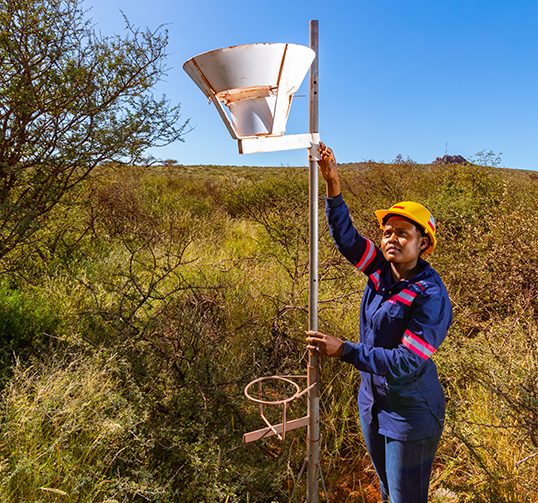
Climate-change considerations are continually integrated into our business strategy. Climate risks influence our short-term strategy through the need to manage related operating costs (including through reduced energy consumption). Our long-term strategy incorporates expected climate-related changes in regulation that will affect costs (particularly energy costs in geographies where fossil fuels have traditionally been dominant), energy supply and the availability of water.
Read more