Climate-change considerations are continually integrated into our business strategy. Climate risks influence our short-term strategy through the need to manage related operating costs (including through reduced energy consumption). Our long-term strategy incorporates expected climate-related changes in regulation that will affect costs (particularly energy costs in geographies where fossil fuels have traditionally been dominant), energy supply and the availability of water.
 |
Refer to the 2022 climate change and water report for ARM’s climate change policy and commitments. |
Climate-change uncertainties are evaluated at the company and asset levels and considered in our climate-scenario analysis. Company-level risks, such as evolving climate-change mitigation regulations (including carbon tax and carbon budgets), are tracked by the responsible risk owners. The ERM process identifies climate-change-related risks in ARM’s top risks.
In F2021, a series of workshops, led by our CEO, conducted a qualitative climate-scenario analysis to assess the resilience of our business to climate transition and physical risks, in line with TCFD recommendations. This informed our long-term GHG emission reduction target, which was approved by the board and announced by the executive chairman at the presentation of our F2021 results.
We are developing decarbonisation pathways and associated measures to ensure we deliver on this commitment in a manner aligned with the global Paris commitment to hold the increase in the global average temperature to well below 2°C and pursue ways to limit that increase to 1.5°C. As part of this process, we assessed the resilience of our business to climate transition and physical risks under five scenarios: 1.5°C – supportive; 2°C – disorderly; 3°C – too little, too late; world transitions and South Africa lags; and business-as-usual.
This process was undertaken in response to and in line with the TCFD recommendations, and because it is critical to informing our understanding of climate-change risks and opportunities, as well as the way they affect our strategy. We have incorporated climate scenarios into our strategic and operational planning again in F2022.
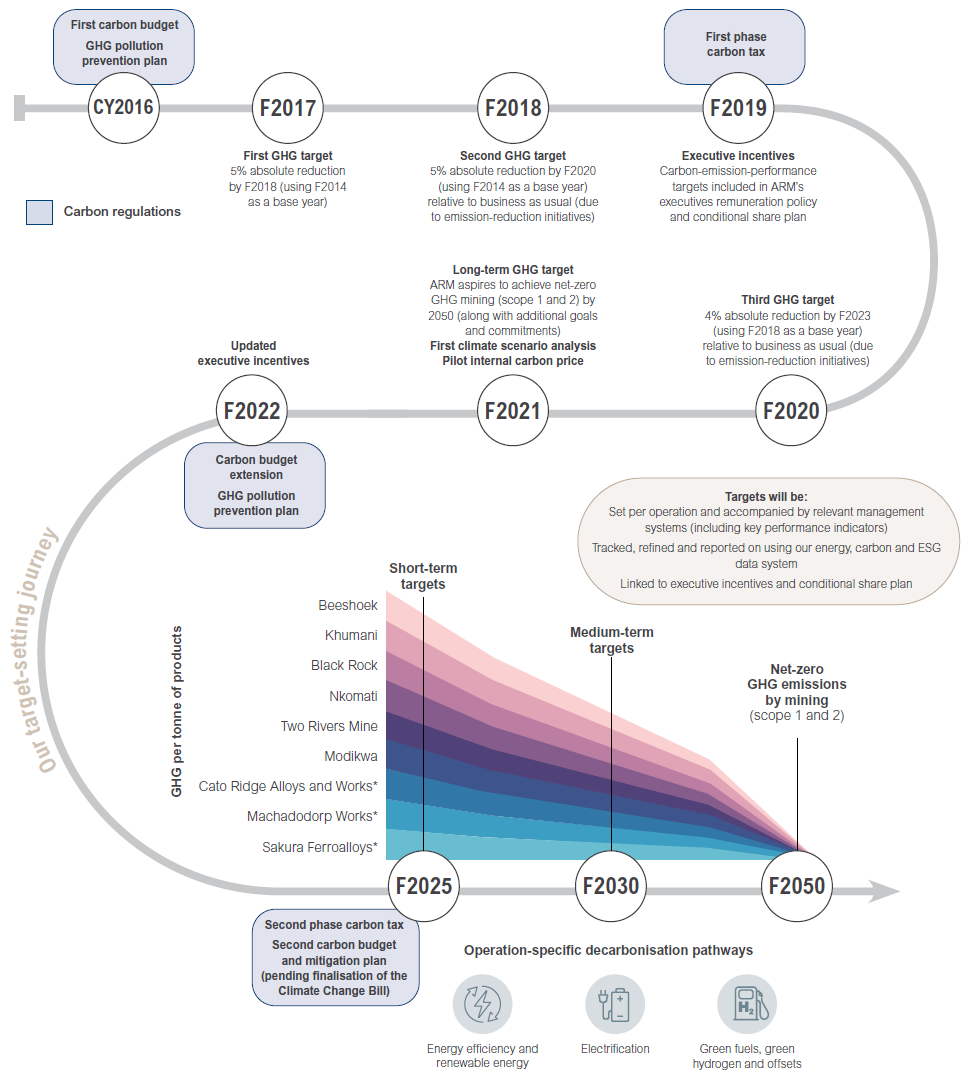
ARM’s long-term GHG emission reduction target
We aim to achieve net-zero GHG emissions (scope 1 and 2) from mining by 2050 and have set goals and commitments to achieve this target.

We have implemented robust processes to measure and report on carbon emissions at our operations and identify opportunities to reduce these emissions. We are actively developing technologies and processes to enhance energy efficiency at our operations while improving fuel efficiency and reducing our carbon footprint through other targeted initiatives.
Figure 1: GHG targets and decarbonisation pathways
To support and complement our decarbonisation pathways and deliver on our long-term ambition, we commit to:
* The smelters are not included in the current net-zero GHG by 2050 commitment, but they are included in the decarbonisation pathway development process.