During a year in which Covid-19 presented multiple challenges, our operations achieved an improved group lost-time injury frequency rate (LTIFR) from 0.45 per 200 000 man-hours in F2020 to 0.41 in F2021. The total recordable injury frequency rate (which measures the number of fatal injuries, lost-time injuries and medical cases) improved by 12% to 0.81 (F2020: 0.92).
As noted by our executive chairman, two colleagues were fatally injured at Modikwa Mine. Remedial actions, as agreed with the DMRE, were implemented. These were augmented by ongoing initiatives across our operations to ensure that safety training continues and standards are strictly upheld.
Safety is a key performance indicator and we reiterate our commitment to achieving zero harm. Notable safety achievements during the year included:
The health and wellbeing of our people remain a key priority. We are assisting our host communities, suppliers and other stakeholders to the fullest extent possible through these uncertain times, as detailed in the ESG report.
Our diversified portfolio of commodities again benefited the group as significantly higher US dollar prices for PGMs and iron ore more than offset the negative impact of a stronger rand against the US dollar. Increased US dollar prices were further augmented by higher sales volumes for iron ore, manganese ore and PGMs. This diversification positions ARM well as we focus on operating a world-class business in a challenging sector.
In line with our strategy to create sustainable value for stakeholders, in F2021 ARM more than doubled total value created to R30.6 billion on a segmental basis. Of this, R18.9 billion was distributed to stakeholders and the balance reinvested in the group.
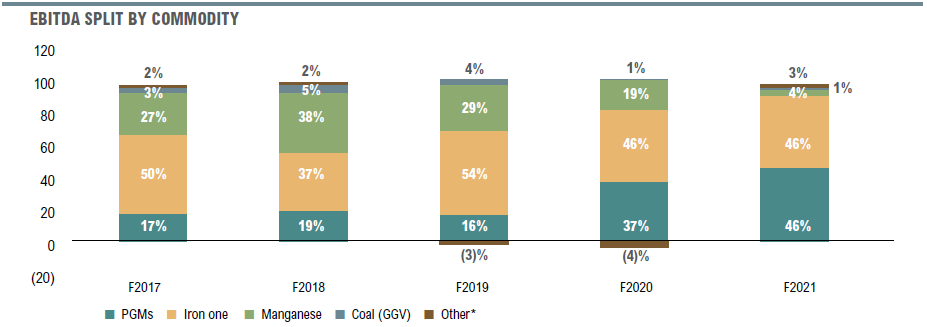
* Other comprises chrome, nickel and ARM corporate.
Headline earnings were 77% higher at R7 927 million (F2020: R4 479 million), as the iron ore division's headline earnings more than doubled to offset a 46% decrease in the manganese division's headline earnings.
Total iron ore sales volumes rose 5% to 16.4 million tonnes (F2020: 15.6 million tonnes). Export sales volumes were 1% higher at 13.3 million tonnes. In contrast, local sales volumes were 29% higher at 3.1 million tonnes (F2020: 2.4 million tonnes), due to above-plan offtake from ArcelorMittal South Africa.
Although iron ore production volumes were affected by water shortages and Covid-19 challenges, we were able to satisfy increased sales volumes through stock. On slightly lower production volumes (-1%), on-mine unit production costs rose 13%, mainly due to inflation and higher working cost waste tonnages.
Headline earnings for the manganese division were down 46%, mainly due to lower average realised US dollar prices for manganese ore as increased global supply put pressure on prices.
Manganese ore sales volumes rose 22% to 3.9 million tonnes (F2020: 3.2 million tonnes), mainly as a result of easing Covid-19 restrictions (compared to F2020) and ramp-up of the Black Rock and Gloria projects. These projects will modernise and expand the mine by increasing volumes and flexibility to produce different products while improving efficiencies. The ramp up is being closely synchronised with Transnet's rail availability and informed by prevailing market conditions.
On-mine unit production costs increased 18% on higher labour costs, inefficiencies after delayed delivery of the Black Rock and Gloria projects, Covid-19 compliance costs and above-inflation increases in insurance and steel-based products.
The Black Rock modernisation and expansion project is more than 90% complete. Once the underground ore-handling systems are commissioned, Black Rock Mine will realise efficiency and productivity improvements that will lower costs and support the ramp-up to 5 million tonnes per annum over time.
Higher metal prices, particularly rhodium (179% higher in F2021), contributed significantly to the results of Modikwa and Two Rivers mines. US dollar nickel prices were 18% higher, which contributed to Nkomati Mine's cash position.
Two Rivers Mine delivered an excellent performance, with a 9% increase in tonnes milled and flat unit costs. Production rates are returning to normal after the national lockdown and operational challenges in F2020.
To enhance feed grade to the plant, Two Rivers Mine is creating more mining flexibility through accelerated deepening at Main shaft. The plant expansion project to add 40 000 tonnes per month milling capacity is underway, with commissioning expected in the third quarter of F2022. This is a world-class mine with over 30 years of life, and the R5.7 billion Merensky project approved by shareholders will expand volumes significantly from 2024.
At Modikwa Mine, a 5% increase in tonnes milled was more than offset by a 7% decrease in head grade, due to higher production from on-reef development at North shaft. Mining volumes were affected by safety stoppages and industrial action in the first half, as well as Covid-19 challenges. The second half saw a much-improved performance, with unit costs declining 17% and volumes increasing by 26%. A number of actions are underway to improve productivity and safety performance. We continue to inject capital to enhance flexibility and mechanisation, which will ramp up milling over the next three to four years to around 240 000 tonnes per month. Commissioning of the chrome recovery plant to recover chrome concentrate from the UG2 concentrator plant tailings stream is underway.
Nkomati Mine was placed on care and maintenance in March 2021. Its rehabilitation obligations have been updated against current legislation, resulting in an undiscounted attributable cost of R679 million which has been fully provided for.
Thermal coal prices increased in F2021 as the global economic recovery led to supply shortages. Production at GGV Mine was impacted by challenges at Transnet, giving rise to full stockpiles. Lower production translated into a 17% rise in on-mine unit production costs.
Production at GGV Mine was impacted by challenges at Transnet, giving rise to full stockpiles. Lower production translated into a 17% rise in on-mine unit production costs.
Production at the PCB operations was also affected by the underperformance of Transnet, as well as challenging conditions in the Klipplaat pit. PCB successfully commissioned a second dragline at Tweefontein Mine midway through the review period. This is expected to improve both production and cost management. Unit production costs per saleable tonne rose 7%, mainly due to lower saleable production.
The pronounced increase in commodity prices in the review period was reflected in record iron ore and PGM prices. Concerns remain about the sustainability of these elevated price levels as global supply for most commodities recovers post-Covid-19, while weatherrelated and other operational disruptions experienced by major suppliers start to abate.
Commodity prices are expected to pull back in the year ahead. However, we remain positive about the outlook for PGMs and excited about their role in global initiatives to reduce carbon emissions, a trend that is expected to remain a key driver for commodity markets in the medium to long term.
In mobility, tightening emissions standards (particularly in China and Europe) are expected to be positive for PGM demand, while disruptive technologies in clean mobility such as electric vehicles are expected to gain greater momentum, posing a threat to PGM demand. We believe the medium to long-term fundamentals of PGMs are robust as supply remains constrained and demand is expected to be supported by the role of PGMs in clean mobility, particularly through hydrogen technology.
The global move to reduced carbon emissions in the steel industry has also resulted in higher demand for high-quality and lumpy iron ore as well as manganese ore products. ARM is well positioned to benefit from sustained demand levels.
We are committed to playing a meaningful role in reducing carbon emissions. As noted, we aim to achieve net zero greenhouse gas mining by 2050. This includes scope 1 and 2 emissions associated with operations under ARM's operational or joint operational management control.
Our success as a group relies on efficient and sustainable provision of water and power as well as the reliability of logistics infrastructure. Challenges experienced by Transnet in the financial year under review, together with those related to water supply in the Northern Cape, are expected to persist into the coming financial year, impacting volumes and costs. We continue to engage and work with government, Transnet, the Sedibeng Water Board and other stakeholders to find sustainable solutions that will benefit the mining industry and the country as a whole.
Our ability to create sustainable value is founded on the commitment and hard work of our employees. As we continue to navigate the challenges of doing business in such uncertain times, I thank each of my colleagues for their contributions, as well as our executive chairman and the board for their expert direction and counsel. I also thank our stakeholders and joint-venture partners for their ongoing support during the year.
Mike Schmidt
CEO
8 October 2021