
2025 Integrated annual report
External trends*
Climate change and drive to net-zero
Pressures of economic inequality and unemployment
Shift to stakeholder capitalism/ESG expectations
Technology shifts – digital and other innovations
New ways of working – impact on talent
Global macro-economic uncertainty
Supply chain and logistical issues
Radical transformation in energy/transport systems
Key ARM risks*
Volatility in commodity prices
Underperformance of Transnet (rail and port)
Unreliable water supply in Northern Cape
Cost escalations
Unreliability and cost of electricity supply
Strategic opportunities to create value from trends and mitigate risks*
Responsible and sustainable transition to low-carbon economy
Creating employment
Contributing to sustainable projects for the benefit of host communities
Addressing water security and other infrastructure challenges
Strengthening partnerships with stakeholders
Realising ARM's full value through share-price performance

*  In descending order from greatest potential challenge to our business model.

Enterprise risk management (ERM)

The timing of the ERM process in ARM is aligned with our assurance and corporate governance requirements. However, risk management is not an activity that takes place only at stated intervals, but continuously through all phases of the business and with every major change in the business and operations. All risk activities are timed to facilitate risk input into the ARM strategic planning process as committed to in our ERM policy.

We report on the results of our risk assessment activities to the following governance structures:

Committee Attendance Reporting
ARM level    
Board   *
Audit and risk    
Social and ethics    
Management risk and compliance    
Technology and information    
Divisional level    
Social and ethics or sustainable development    
Audit and risk    

*  Annually.

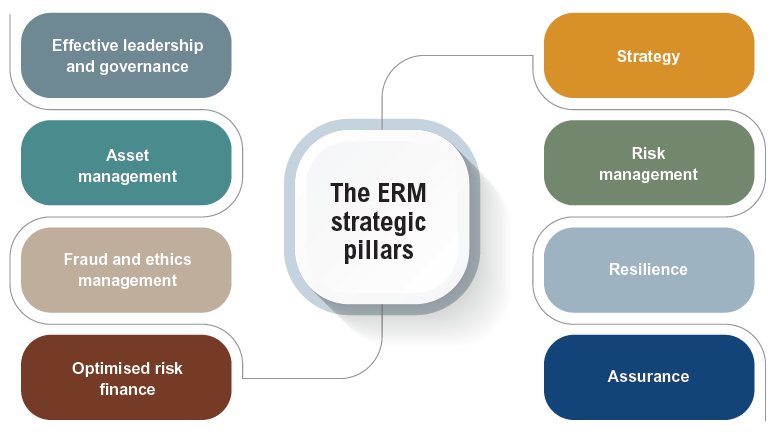
Our ERM strategic pillars are aimed at integrating various risk management disciplines that will ultimately drive us towards a desired position.
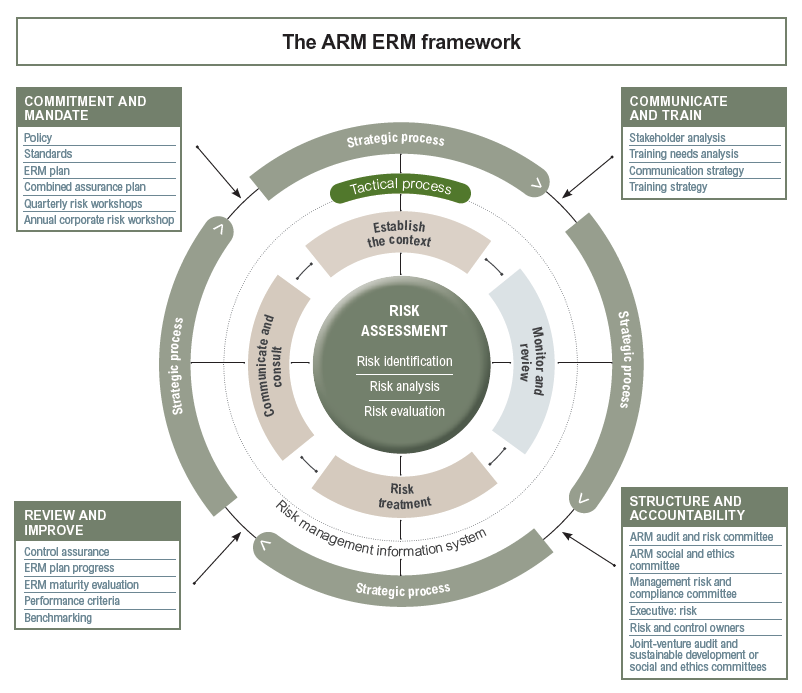
Our risk management framework is premised on the principles of ISO 31000:2018 and contains all the necessary elements shown on the previous page. Our risk assessment process is outlined below.
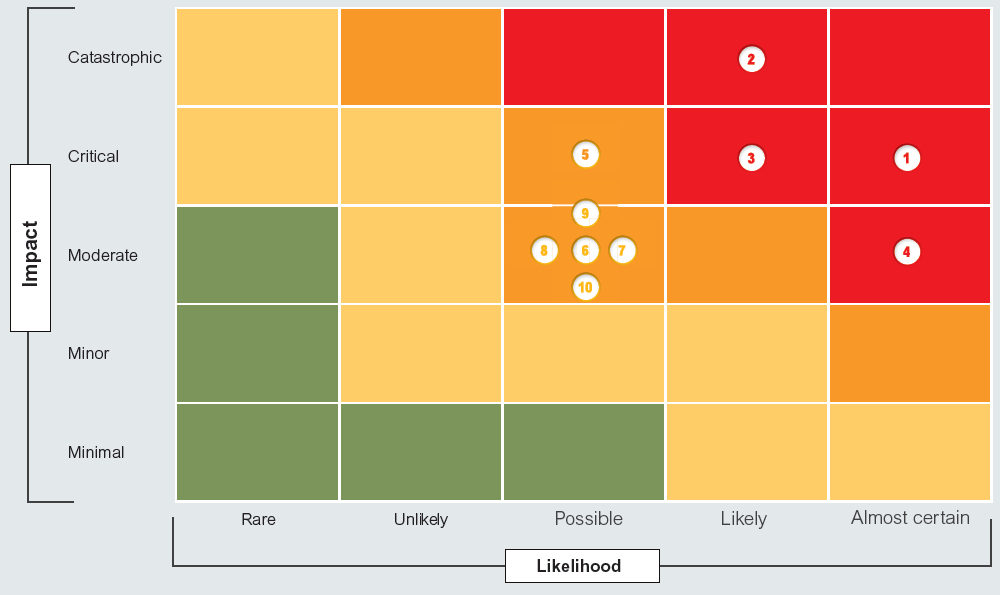
Residual risk dashboard

Our top 10 risk profile as at end-June 2025
ARM has a number of policies and frameworks that govern how we manage risk, resilience, assurance, asset management and other aspects of our risk (details are available on request). Current notable policies and frameworks include:

  • ERM policy
  • Business continuity management (BCM)
  • Risk appetite and tolerance standard
  • Capital allocation framework
  • Whistleblower policy
  • Combined assurance
  • ERM framework
  • ERM standard.
Risk Our response
1
Continuing volatility in commodity prices (potential upside/downside)
 
  • Cash preservation and costcontainment initiatives, including rightsizing labour complement
  • Enhancing productivity
  • Efficient allocation of capital.
2
Underperformance of Transnet (rail and ports) due to poor state of infrastructure
 
  • Weekly engagement with Transnet by dedicated executives
  • Revised annual production in line with Transnet's performance
  • Road-haul contingency for manganese
  • Engaging through forums in collaboration with other mines via MCSA and DMPR.
3
Delay in project execution, inefficient capital allocation, and unrealised value
 
  • Scenario planning to establish options for the business to consider
  • Ongoing engagement with key stakeholders, including communities, Eskom and service providers
  • Capital reporting through maintenance of capital book
  • Dedicated project management resources
  • Project governance structures in place.
4
Data privacy, cyber, including business continuity preparedness
 
  • Business continuity preparedness.
  • Processes are ongoing.
Risk Our response
5
Increased production unit costs and reduced recoveries
 
  • Five-year business plans enable forward planning over short and medium term
  • Mid-year business plan review to assess impact of economic outlook and output of scenario analysis
  • Developing business initiatives to reduce costs and optimise processes.
6
Increased optionality for growth (opportunity risk)
 
  • Organic review of growth opportunities across all commodities.
7
Safety performance deteriorated
 
  • Zero tolerance for safety incidents at all operations
  • Visible felt leadership where mine management identifies gaps and improvements in management systems and behaviour while demonstrating their commitment to safety, health and environment
  • International Standards Organization (ISO) accreditation for relevant disciplines
  • Employees made aware of section 22 notice (MHSA) that recognises their responsibility to take reasonable care to protect their own and other people's safety and health
  • Employees made aware of section 23 notice (MHSA) that recognises their right to refuse to work in an unsafe environment
  • Risk assessments (baseline, issuebased, etc) in place.
8
Increased ESG requirements
 
  • ARM's approach to ESG is informed by industry initiatives, good practice, and local and international guidelines and frameworks
  • Committed to net-zero GHG emissions from mining by 2050
  • ARM suite of annual reports provides comprehensive disclosure
  • ESG principles are inherent in business processes, systems and decisions
  • Aligned to GISTM
  • Robust governance structures in place
  • Financial provision for closure in place.
9
Unreliable water supply and delayed pipeline upgrade project in the Northern Cape
 
  • Ongoing engagements with Vaal Central Water Board (VCWB) to ensure reliable water supply
  • Mine leadership forum provides technical, financial and governance oversight and drives collaborative engagements through the MCSA
  • On-site water-storage facilities
  • Recovery and recycling of stormwater and process water.
10
Restructuring of operations, resulting in low staff morale
 
  • Employee wellness programmes in place.