
In another challenging year, our operations further improved their safety performance, reducing the group LTIFR by 13%. The total recordable injury frequency rate improved by 10%. Regrettably, this performance was marred by the loss of a contractor employee in the first half of the financial year.
Phillip Tobias
Chief executive officer (CEO)
Mr Seutlwadi Esron Ramathesela, an engineering assistant, was injured at Two Rivers Mine in November 2022 and later succumbed to these injuries. Our sincere condolences go to his family, friends and colleagues. We are committed to zero harm and we continueto focus on initiatives across our operations to reinforce continual safety training and ensure safety standards are strictly upheld.
Underscoring this commitment to zero harm, safety is a key performance indicator in executive remuneration. Safety achievements during the year included:
We prioritise the health and wellbeing of our people. We also continued to assist our host communities, suppliers and other stakeholders as much as possible in these uncertain times, as detailed in the ESG report.
In F2023, ARM created total value of R21.2 billion (F2022: R27.5 billion). Of this, R6.7 billion was paid to shareholders as dividends and around R1.6 billion accrued to providers of capital. We also reinvested R3.6 billion in the group to support our continued growth.
The financial and operational reviews on pages 42 to 87 detail our performance for the year. My review focuses on progress against strategic objectives more broadly and the significant infrastructure challenges facing our operations.
Strategic focus areas
To navigate uncertain economic cycles and ensure maximum value from our portfolio of competitive assets, we are focusing on:
Scaling our PGM portfolio
As noted by the executive chairman, Bokoni Mine is an important milestone for our group, and an opportunity to create significant value. As the second largest PGM resource in South Africa, it has operated for over 48 years but was placed on care and maintenance in 2017 due to adverse market conditions.
This acquisition gives ARM access to Bokoni Mine’s large, high-grade resource and existing infrastructure. Good progress has been made in advancing the definitive feasibility study. This is based on a phased development approach to reduce peak funding requirements, optimise production ramp-up and minimise project execution risk. The study also preserves the optionality to increase production to an optimal rate in the future.
The early-ounce project approved in March 2023 is progressing well, with the first saleable PGM concentrate expected by December 2023.
Increasing access to and use of renewable energy
In F2023, we signed a power-purchase agreement with an independent power producer to wheel 100MW of renewable solar photovoltaic (PV) power to our platinum operations. ARM Platinum studies indicate that wheeling this quantum of renewable energy over 20 years could generate some 4 900GWh of electricity and save around 4.8mtCO2e in carbon emissions. Construction of the solar PV facility started in October 2023. Electrical energy from this facility is expected to begin supply to ARM Platinum’s mining operations in F2026.
In our Ferrous division, the Northern Cape mines are progressing with a prefeasibility study to explore the correct energy mix that will cater for baseload demand.
The ARM TSF management policy and standard, which align with the ICMM’s GISTM, are being implemented at all ARM Platinum and ARM Ferrous operations. Conformance to the GISTM was self-assessed at Nkomati, Two Rivers, Modikwa, Black Rock and Khumani mines during the year, followed by GISTM conformance verification third-party validation in July 2023. In August 2023, ARM released a public report on conformance to the GISTM, which is available on our website. See operational reviews from page 58 for more details.
The performance of our operations remains hampered by the unreliable supply of power, water and logistics. Despite the impact of above-inflation input cost escalations, each operation is focused on improving efficiency and containing costs.
Logistical constraints
Transnet rail and port performance for iron-ore, manganese-ore and coal export remains severely constrained. The challenges, however, are deeply rooted and cannot be resolved in the short to medium term. Significant capital, proper maintenance, competent operational management, and thorough project planning, including procurement and execution, are urgently needed.
In December 2022, the Transnet board and Minerals Council South Africa established joint collaboration structures to work together to identify and ensure all necessary actions are taken to stabilise and improve the transportation of commodities through the rail lines and ports of South Africa. ARM is actively involved in these structures to ensure we achieve the goal of improved, efficient and cost-effective transportation of our commodities for the benefit of our shareholders, stakeholders and the country.
The risk section on pages 35 to 37 details infrastructure constraints in both rail and port, as well as the unreliability and cost of electricity supply as our top two risks. These have a direct bearing on our number three risk, cost escalations (both capital and operating expenditure).
We are implementing efficiency-improvement and cost-containment initiatives at all operations to mitigate above inflationary unit cost-increases. Extensive work is also underway to identify opportunities to sustainably reduce our carbon emissions.
In a year characterised by volatile commodity prices, our diversified portfolio again benefited the group. As illustrated on page 40, this diversification positions ARM well, as we focus on operating a world-class business in a challenging sector.
In summary:
Volatility in global commodity markets continues to be driven by multiple sources of uncertainty. These include a potential slowdown in growth in both China and the rest of the world, continued high inflation, tightening monetary policy across major economies, lingering economic repercussions from Covid-19 as well the conflict in Ukraine. Global commodity markets have further been impacted by a series of supply shocks, mostly driven by weather-related events.
Sentiment on China’s growth expectations continues to disappoint as economic data surprises on the downside. The recovery in China’s metal demand has fallen behind market expectations and is expected to remain sluggish in the second half of 2023, putting pressure on metal prices.
In the medium to long term, slowing infrastructure spend and crude steel production in China are expected to put pressure on demand for iron ore, although iron ore producer cost pressure is expected to provide some support to prices. Additional supply from new projects in Africa could bring in low-cost production, further increasing the downward risk to prices.
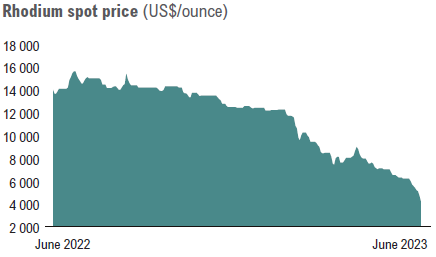
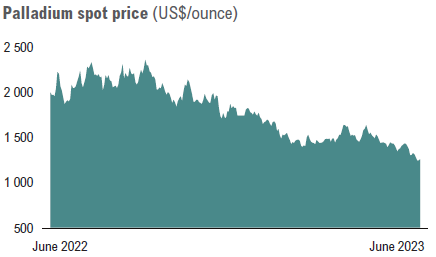
PGM prices have come under immense pressure, with US dollar basket prices reducing by more than 30% since the start of calendar year 2023. In the medium term, we are cognisant of the threat from increased electric battery vehicle production. However, recovery in autocatalyst demand and tightening emission standards are expected to be positive for PGM demand, while the role of platinum in clean mobility (through hydrogen technology) is expected to provide price support in the longer term.
Infrastructure-related challenges in South Africa – including rail and port performance as well as reliable supply of power and water security – remain a significant risk for ARM operations and are expected to continue putting pressure on volumes and, in turn, unit costs. We are working with government and other stakeholders to find sustainable solutions that benefit the mining industry and the country. Although Transnet and Eskom’s operational challenges remain significant, there have been some positive shifts recently that point to a constructive longer-term reform trajectory. These include the establishment of the government-business logistics recovery steering committee, and corporates pledging to support government, which bodes well for structural reform and investment. We are encouraged by these developments, though such momentum will need to be maintained and deepened in coming months.
We remain focused on positioning our operations to deliver into this increased demand by: producing high-quality commodities that benefit from the green energy transition; exploring value-enhancing growth opportunities; containing unit cost escalations; applying innovative technologies; and delivering approved capital projects on time and on budget.
Segmental EBITDA split by commodity (%)
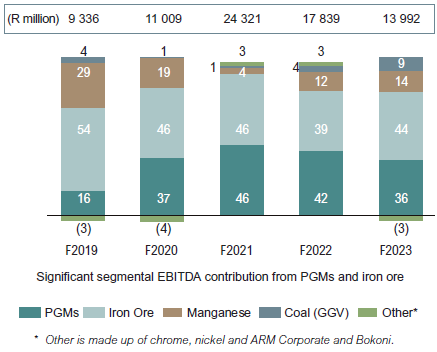
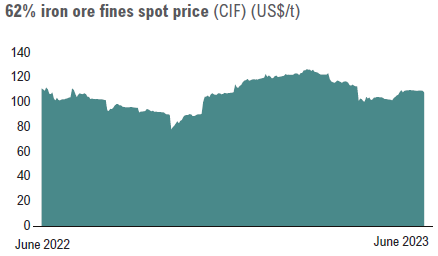
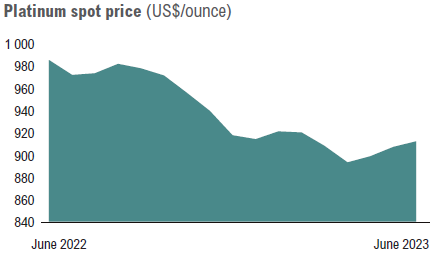
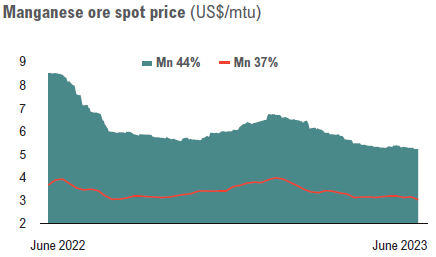
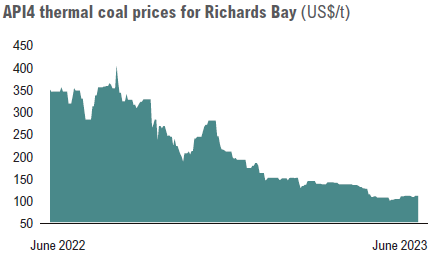
See operational reviews for commodity price forecasts.
We are focused on cost containment and improving our global cost position as well as ensuring our iron ore operations benefit from the move to reduce carbon emissions in the steel industry globally.
Our ability to create sustainable value is underpinned by the commitment and dedication of our employees. I thank all my colleagues for the value they add to our group, as well as our executive chairman and the board for their expert direction and counsel.
This is my first report as CEO. I will continue to build on the excellent foundations laid by Mike Schmidt and his predecessors as we navigate the challenges of doing business in the prevailing global uncertainty.
We are fully committed to maintaining mutually beneficial relationships with all our stakeholders and joint-venture partners to ensure we build a resilient and enduring business that creates sustainable value for all.
Phillip Tobias
CEO
10 October 2023